Reverse Engineering
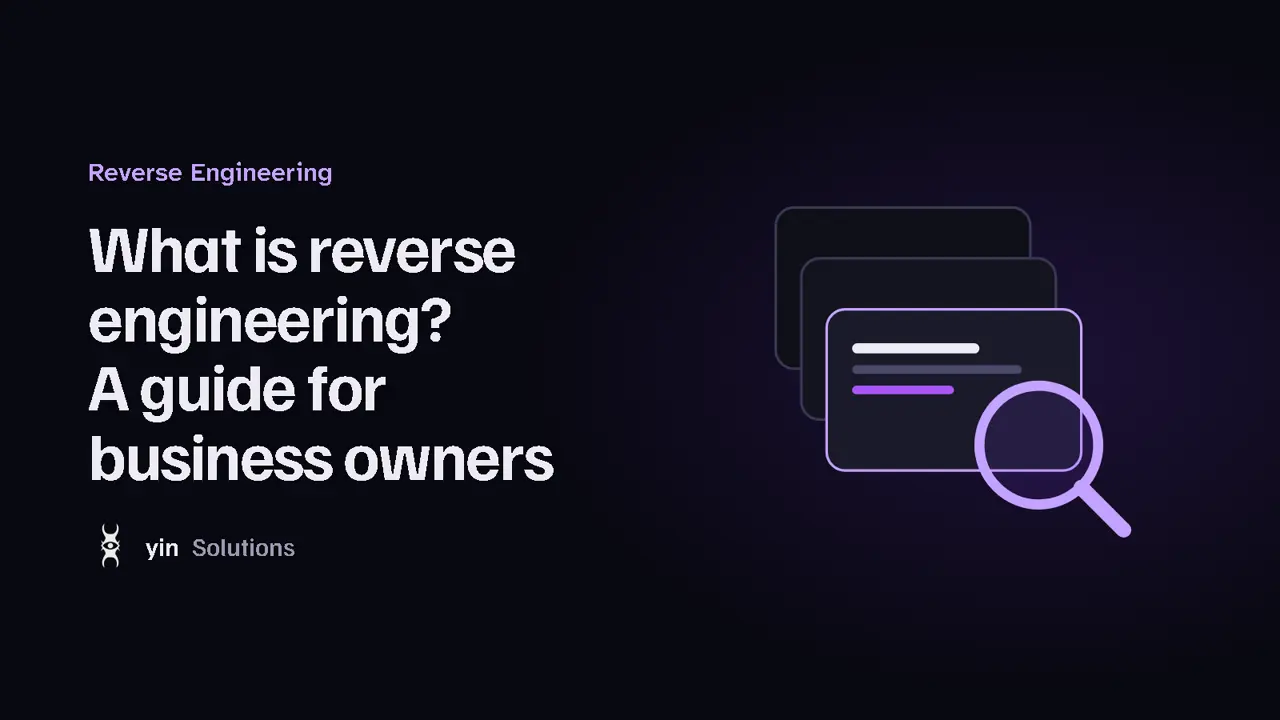
What Is Reverse Engineering? A Plain-English Guide for Business Owners
Reverse engineering sounds mysterious, but the idea is simple: understanding how something works by studying the finished product. Here is when it helps a business, and how to do it the right way.
 yin Solutions
Published
Updated
3 min read
yin Solutions
Published
Updated
3 min read
Reverse engineering in one paragraph
Normally, software is built from source code: human-readable instructions that a developer turns into a finished program. Reverse engineering works in the opposite direction. A specialist studies the finished program to understand what it does and how its parts fit together, usually because the source code or documentation is missing. Think of it as a mechanic studying an old engine for which the manual was lost.
Legitimate reasons businesses use it
Legacy software
A program your business depends on was built years ago, the developer is gone and nobody has the source code. Reverse engineering shows how it works so it can be maintained or replaced safely.
Compatibility
You need an old system to exchange data with a new one, but the file format or protocol was never documented.
Security reviews
Checking your own app or a product you are about to deploy for weaknesses, such as passwords left inside the code.
Due diligence
Before buying software or a company, confirming that the product really does what the seller claims.
The legal ground rules
Reverse engineering is a normal part of the software industry, but it has limits. The rules differ by country and contract, so treat this as general information rather than legal advice:
- Work on software you own or are authorized to analyze. For anything else, get written permission and an agreed scope first.
- Read the licence. Some licence agreements restrict reverse engineering, although many countries allow it for specific purposes such as compatibility (for example, the EU Software Directive).
- It is never a way around paying for software or getting around copy protection. Legitimate work respects copyright.
- Handle findings responsibly. If a security issue affects someone else’s product, report it privately to the vendor.
Our policy
We only take on projects with clear authorization from the software owner, and every engagement starts with a written scope.
What a professional project looks like
- Conversation: you explain the problem in your own words - no technical knowledge needed.
- Scope and agreement: we confirm ownership or authorization, and agree what will be analyzed and what you will receive.
- Analysis: specialists study the software with professional tools such as IDA Pro or Ghidra in a controlled environment.
- Report: you get a clear explanation of how it works, what the risks are and the recommended next steps.
- Follow-up: optional help with documentation, data migration or fixes.
A word about the tools
You will often see tools such as IDA Pro mentioned. They are the equivalent of a mechanic’s diagnostic equipment: powerful, but only as good as the person using them. What matters to a business is not the tool, but a clear, well-documented answer to its question.
Is it right for your business?
Reverse engineering is worth considering when you rely on software you can’t change, need two systems to talk to each other, or want independent assurance about security. If any of these sound familiar, tell us about it - we’ll tell you honestly whether it is the right approach. You may also like what happens in a mobile app security audit.
Frequently Asked Questions
Is reverse engineering legal?
Do I need technical knowledge to hire a reverse engineer?
Can reverse engineering recover lost source code?
How long does a project take?
Key takeaways
- Reverse engineering means understanding software by studying the finished program.
- Common business uses: legacy software, compatibility, security reviews and due diligence.
- Only work on software you own or are authorized to analyze, and respect copyright.
- A good project starts with a written scope and ends with a plain-language report.