Certificate Pinning
The full server certificate is embedded in the app. Maximum security, but any certificate rotation by the server requires a new app release to keep working.
If you've searched "how to bypass SSL pinning Instagram iOS" you're in good company. This article explains what certificate pinning is, how it's implemented across major apps, and how the ecosystem of pre-configured iOS IPAs has emerged to serve researchers and testers.
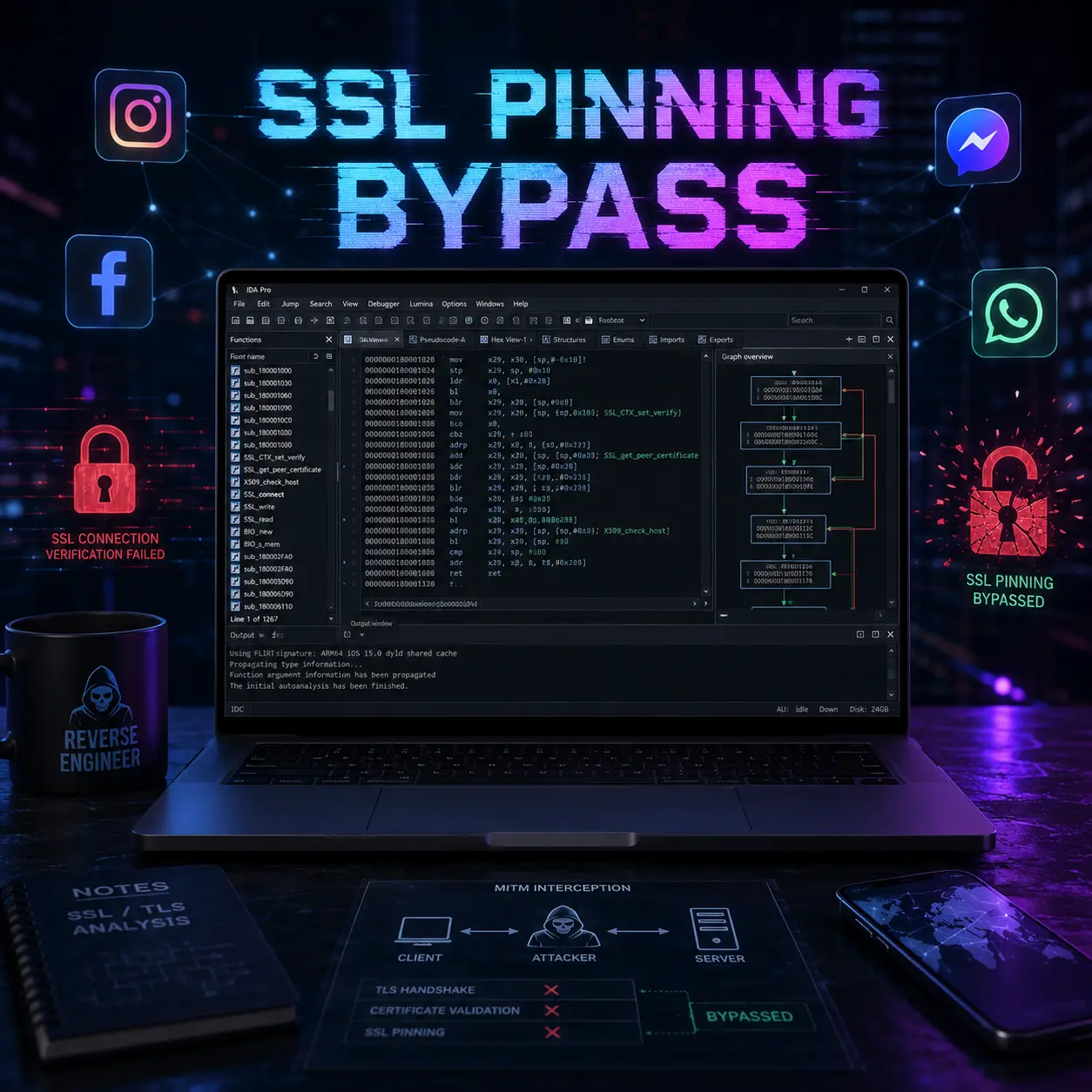
SSL pinning—also known as certificate pinning—is a security mechanism built into iOS applications that restricts network communication to a pre-approved set of servers. Rather than relying on the device's trusted certificate authority (CA) store, a pinned app carries its own known-good certificate fingerprint or public key hash directly inside the app bundle.
Apps like Instagram, Threads, Facebook, and Snapchat embed these values at build time. When the app makes a network request, iOS checks the server's presented certificate against the pinned value. A mismatch results in an immediate connection termination—no data is exchanged, no session is established, regardless of what the device's CA store says.
There are two primary forms of pinning in production iOS apps, each with different operational tradeoffs:
The full server certificate is embedded in the app. Maximum security, but any certificate rotation by the server requires a new app release to keep working.
Only the server's public key hash is stored. Certificates can be renewed without an app update as long as the same key pair is retained. Preferred by large platforms for operational flexibility.
Instagram, Threads, and Facebook all use public key pinning as their primary mechanism—it decouples certificate rotation from app release cycles while preserving the core security guarantee that the app only communicates with verified Meta servers.
SSL pinning has become standard practice across the most security-conscious iOS applications. Here's how each of the major platforms approaches it:
Public key pinning on all API endpoints. One of the most robust implementations on the App Store, covering login, feed, media upload, and messaging.
Shares Meta's security infrastructure. Certificate pinning is consistent with Instagram's approach across all API calls—implemented from day one of launch.
Multi-layer certificate validation combined with runtime integrity checks. One of the earliest major apps to adopt aggressive pinning at scale.
Certificate pinning on media upload and messaging endpoints, supplemented by binary obfuscation to make static analysis of the implementation more difficult.
Growing interest in topics like "SSL pinning iOS" and "certificate pinning Instagram" has driven a parallel ecosystem: platforms that distribute pre-configured IPA files where specific behaviors have already been adjusted before the app reaches the end user.
Rather than requiring users to engage directly with binary patching, certificate extraction, or dynamic instrumentation frameworks, pre-configured solutions come fully assembled. The networking configuration or certificate validation behavior is handled at the binary level during IPA preparation—not at installation time by the user.
As demand for pre-configured iOS environments has grown, dedicated marketplaces have emerged to serve the research and testing community.
reversio.net is one example of a marketplace listing pre-configured iOS applications for research and testing environments. Their catalog includes IPA files associated with popular platforms—including apps inspired by Instagram, Threads, Facebook, and Snapchat—where advanced configurations such as networking behavior and certificate validation handling have been applied prior to distribution.
Rather than walking users through SSL pinning bypass techniques, platforms like this focus on providing ready-to-use environments for practitioners exploring advanced iOS functionality, automating what would otherwise require significant binary analysis expertise.
These resources are best understood through a research and educational lens—they illustrate how the iOS security ecosystem evolves and how the community adapts as platforms raise their defenses.
SSL pinning remains an essential defense layer in modern iOS development—and it continues to evolve. Developers at major platforms don't treat it as a static checkbox; they actively improve and supplement it:
This ongoing evolution makes iOS app security one of the most active areas of both offensive research and defensive engineering—each side continuously learning from the other.
SSL and certificate pinning give apps like Instagram, Threads, Facebook, and Snapchat meaningful protection against network interception—going well beyond what the iOS system CA trust store provides. Understanding how it works is valuable for iOS developers building secure apps, security researchers auditing mobile applications, and QA engineers who need to test network behavior.
The emergence of pre-configured IPA marketplaces reflects how this knowledge has scaled into a broader ecosystem, making advanced iOS research environments accessible without requiring deep binary analysis expertise at every step.